

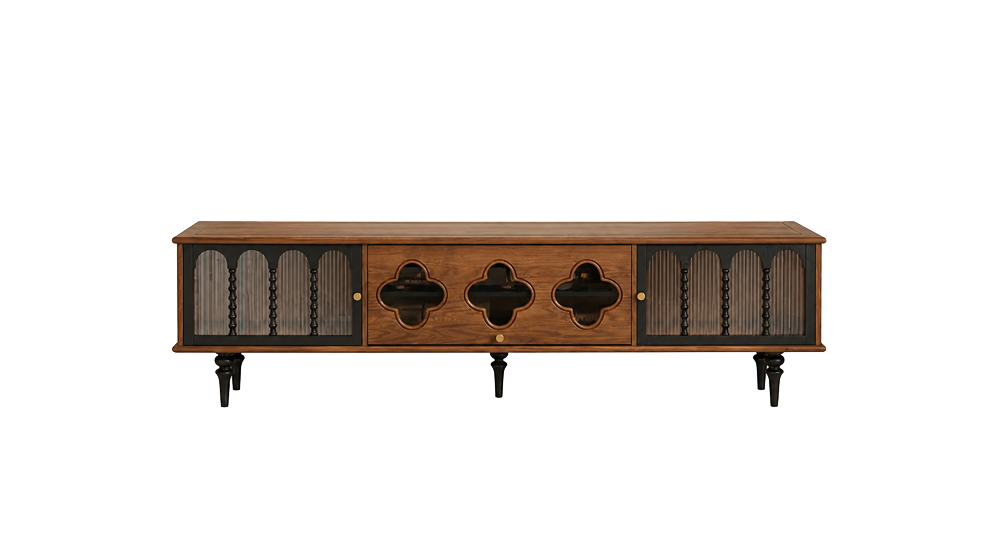

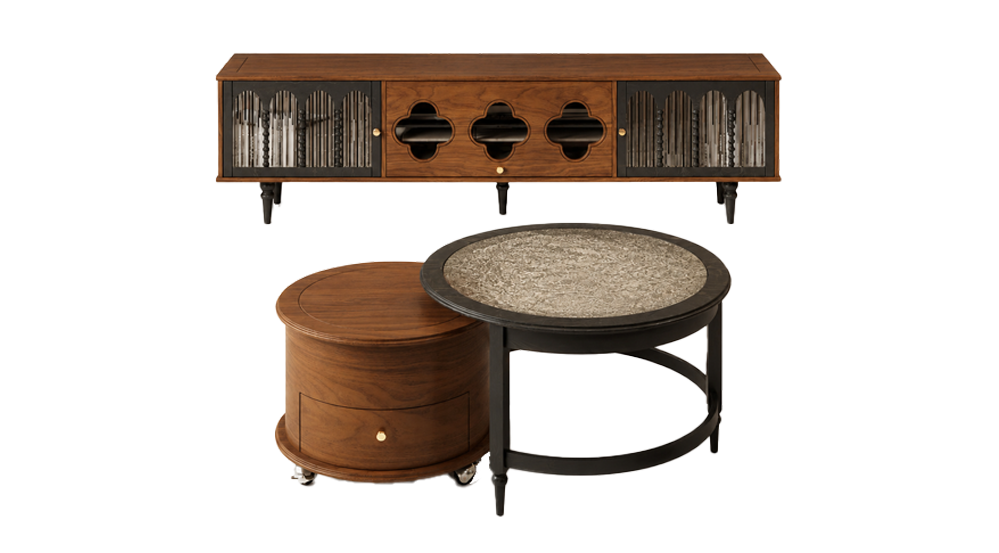

When people search for a mid century TV stand, one question almost always follows:
“Is it real wood?”
It sounds simple, but it’s rarely that straightforward. In fact, focusing only on whether something is solid wood or veneer often leads buyers to miss the more important question:
How will this piece perform in your home, over time?
The answer depends less on material labels and more on how you live.
Why This Question Comes Up So Often
There’s a strong emotional pull behind “real wood.” It suggests honesty, durability, and permanence. And in many cases, that association is justified.
But in the world of mid-century furniture, the story is more nuanced.
Original mid-century modern designs from the 1950s and 1960s frequently used veneer—often beautifully executed walnut or teak veneer over plywood cores. It wasn’t a shortcut. It was a deliberate design choice that allowed for stable panels, dramatic grain patterns, and refined silhouettes.
So when buyers assume that veneer automatically means “cheap,” they’re often reacting to lower-quality modern manufacturing—not to veneer itself.
The real fear isn’t veneer. It's a premature failure: peeling surfaces, warped panels, or a piece that feels disposable after a few years.
That’s a fair concern. But it’s not solved by choosing solid wood alone.
Real Wood: Where It Truly Makes a Difference
Solid wood has genuine advantages—especially in certain living situations.
Structural Integrity Over Time
A well-built solid wood TV stand, particularly one with solid hardwood framing and quality joinery, tends to age gracefully. If properly kiln-dried and constructed, it can handle years of weight from televisions, media equipment, and daily use.
However, it’s important to separate “solid wood” from “solid wood everywhere.” Many pieces marketed as solid wood use hardwood for visible panels but engineered materials internally for stability. That’s not deception; it’s practical engineering.
What matters most is how the load-bearing structure is built. Thick solid hardwood rails and reinforced corner joinery will outlast thin panels, regardless of surface material.
Repairability and Refinishing
One of the clearest advantages of solid wood is repair.
Scratches can often be sanded out. Surface wear can be refinished. Dents can be filled and re-stained. If you plan to keep your TV stand for a decade or more, this flexibility matters.
In homes with children or pets—where furniture inevitably takes a few hits—solid wood offers a margin of forgiveness.
When It’s Worth the Investment
Solid wood makes the most sense when:
-
You’re furnishing a long-term home.
-
You care about refinishing potential.
-
You expect the piece to age alongside you.
-
You prefer natural variation over uniformity.
If you think of furniture as something you’ll keep for 10–15 years or more, solid wood often earns its cost. You’ll often see this reflected in higher-end solid wood TV stands, where construction and material work together for long-term use.
Veneer: When It’s Not a Compromise
The word “veneer” has suffered from association with poorly made furniture. But high-quality veneer over plywood or engineered cores can offer real advantages.
These materials often work together in furniture construction rather than replacing one another.
Solid wood refers to boards made from a single species of natural lumber, commonly used in frames, legs, and structural components.
Plywood (multilayer wood) is made from thin wood veneers laminated in alternating grain directions to improve strength and dimensional stability.
Veneer is a thin slice of real wood applied over a stable core material to achieve consistent grain appearance and reduce movement in wide panels.
Material labels alone don’t determine quality. Construction methods and core materials matter just as much.
Stability Against Warping
Solid wood expands and contracts with humidity changes. That’s natural. In very dry or very humid environments, wide solid panels can shift slightly over seasons.
A veneer applied over stable plywood resists that movement. In apartments with fluctuating heating or in regions with seasonal humidity swings, veneer construction can actually reduce the risk of visible warping.
In other words, veneer can be more dimensionally stable than solid wood in certain conditions.
Design Precision and Grain Control
Mid-century design is known for long horizontal lines and symmetrical grain patterns. Veneer allows manufacturers to control grain flow and maintain visual consistency across large surfaces.
That’s why many classic walnut pieces from the era relied on veneer for their signature look.
When Veneer Makes Practical Sense
Veneer construction is often the right choice when:
-
You’re renting or expect to move frequently.
-
Budget matters more than heirloom longevity.
-
The piece won’t be subjected to heavy daily wear.
-
You prioritize weight (veneer units are often lighter).
For many households, especially in smaller urban apartments, veneer over quality plywood strikes a smart balance between aesthetics and cost.
Real Wood vs. Veneer: A Side-by-Side Comparison
| Feature | Real Wood TV Stand | Veneer TV Stand |
|---|---|---|
| Structural Strength | Strong, depends on joinery quality | Strong when built over quality plywood |
| Humidity Resistance | Can expand or contract seasonally | More dimensionally stable |
| Surface Repair | Can be sanded and refinished | Limited repair depth |
| Weight | Heavier | Typically lighter |
| Cost | Higher investment | More budget-accessible |
| Long-Term Lifespan | Often decades with care | Varies by core quality |
| Resale Value | Generally stronger | Moderate |
This comparison isn’t about declaring a winner. It’s about understanding trade-offs.
The Part Most Articles Skip: Construction Matters More Than Surface Labels
Here’s where many buying guides oversimplify.
Whether a mid century TV stand is solid wood or veneer is only one piece of the equation.
The real durability factors are:
-
Frame construction
-
Joinery method
-
Drawer slide quality
-
Back panel thickness
-
Hardware integrity
A veneer cabinet built over thick plywood with reinforced joinery will outperform a poorly assembled “solid wood” piece made from thin panels and weak connectors.
When evaluating options, look beyond the headline material description. Ask how the structure is built. That tells you more about lifespan than surface terminology alone. This is also why understanding how flexible storage and construction work together matters—especially in living rooms designed to adapt over time.
Mid Century Authenticity: A Brief Reality Check
There’s a persistent myth that “true” mid-century furniture must be solid wood throughout.
Historically, that’s not accurate.
Designers of the era embraced veneer not because it was cheaper, but because it enabled:
-
Stable wide surfaces
-
Clean, uninterrupted grain
-
Slim, elegant profiles
If your goal is stylistic authenticity, veneer is not inherently less legitimate. The quality of execution is what matters.
How to Decide What’s Right for Your Home
Instead of asking, “Which is better?” try asking:
What does my home actually require?
Choose real wood if:
-
You’re furnishing a permanent residence.
-
You value refinishing potential.
-
You expect heavy daily use.
-
You prefer natural aging over visual consistency.
Choose veneer if:
-
You move often.
-
Budget flexibility is important.
-
You want lighter weight.
-
You live in a climate with significant humidity shifts.
Neither choice is universally superior. The right decision depends on time horizon, lifestyle, and expectations.
A Final Thought on Mid Century TV Stands
A mid century TV stand isn’t just a place for a screen. It anchors your living room, carries electronics, and often holds everything from remotes to family photos.
Material choice matters—but only in context.
When real wood matters, it’s usually because you’re investing in longevity and repairability.
When veneer works, it’s often because stability, cost, and practicality are better aligned with your life right now.
Understanding that difference doesn’t just help you buy smarter. It helps you choose a piece you won’t question six months later.
And that’s what good furniture should do.